



Less targeting, better performance: a new AI driven Meta Ads model for 2026 a Case Study from Digital Sales
CASE STUDY – META and Facebook ADS
Less targeting, better performance: a new AI driven Meta Ads model for 2026
Client
Titan Driveways is an Irish company specialising in paving and outdoor construction. They provide services such as asphalt, block paving and hardscaping for both residential and commercial clients. Their focus is on durable, practical and visually appealing solutions for driveways, patios and outdoor spaces.
The Challenge
The business was already investing in paid traffic, but by early 2026 it was facing common challenges in a competitive local market:
- High cost per lead, putting pressure on profitability
- Broad targeting reaching users with low buying intent
- Difficulty scaling without losing lead quality
There was also an overreliance on wide audiences and limited use of first party data, which restricted how well Meta’s algorithm could optimise campaigns. This led to wasted budget and inconsistent results.
The goal was simple: increase quote requests through the website, lower the cost per lead and maintain or improve lead quality without increasing spend.
Previous Setup
The original structure followed a traditional approach with detailed targeting and manual control.
Campaigns were split by service type such as asphalt, paving and hardscaping, each with its own audience based on interests and behaviours. Creatives were tailored to each service.
While this gave control and clear messaging, it also created limitations:
- Fragmented data and audiences
- Limited learning at ad set level
- Reduced ability for the algorithm to identify broader patterns
- Scaling required higher costs
In short, the account worked on a small scale but struggled to grow consistently.
Strategy
The shift was based on one key idea: simplify the structure to improve AI learning, while keeping strategic direction.
Instead of multiple campaigns competing, a unified setup was introduced:
- One campaign covering all services
- A single ad set
- Advantage+ used for dynamic audience targeting
- A mix of creatives across services and angles
This consolidation gave the algorithm more and better data, helping it understand user behaviour and intent more effectively.
Creatives also played a bigger role. Rather than relying on predefined audiences, different ads acted as test variables, allowing the algorithm to match the right message with the right user.
Innovation
A key addition was focusing on user context, something often overlooked in performance campaigns.
Ads were only shown to users connected to Wi Fi. This prioritised people in a more settled environment where they were more likely to pay attention and take action.
This reduced low intent interactions, such as users on the move, and improved engagement quality.
Placement testing was also carried out across Feed, Stories and Reels. Facebook Feed delivered the strongest results, suggesting that for local services, more stable browsing environments perform better than fast moving formats.
Results
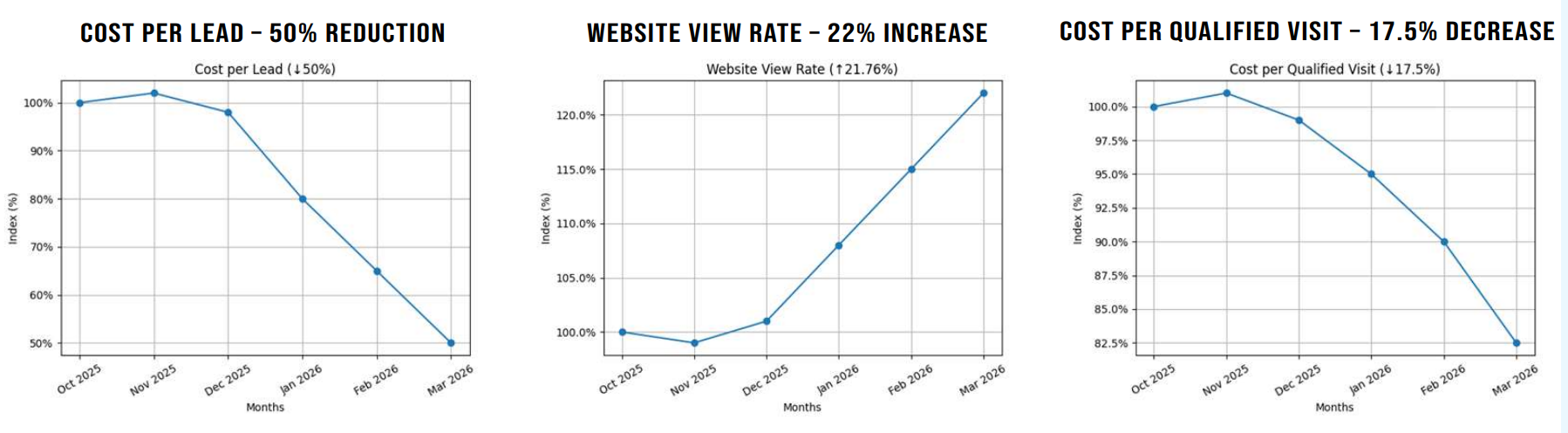
Comparing Q1 2026 with the same period the previous year, the new approach delivered clear improvements:
- 50% reduction in cost per lead
- 21.76% increase in website view rate
- 13.88% increase in CTR
- 17.50% reduction in cost per qualified visit
Beyond lowering costs, the overall efficiency improved significantly. Meta’s AI identified stronger behavioural patterns than manual targeting, while varied creatives boosted delivery and learning.
The Wi Fi filter also improved traffic quality, leading to higher conversion rates and less wasted spend.
In practical terms, this meant more genuine sales opportunities, better quality leads and a more predictable and scalable paid traffic channel for Titan Driveways.
Download the Facebook AI Ads Case Study pdf here
Related Posts:


Comments are closed.